New: Boost's Raiser's Edge NXT Integration now supports Galas, Auctions, and Reunions
Learn More


This four-phase giving program drove 73% current-family participation. Here's how you can run their playbook in a school of any size.
"We want our giving page to feel less transactional."
That's how Ho-Duong Nguyen, Development Database Manager at University Prep (UPrep), a 6-12 independent school in Seattle, describes what she set out to build when the school moved to Boost. In year one, her five-person development team raised $1,439,455, surpassing their $1.3M annual Puma Fund goal, after switching to Boost My School.
Here's how UPrep built an annual giving strategy that accomplished Ho-Duong’s goal (and that can be replicated in a school with a different size and giving history).
UPrep is a 50-year-old, 6-12 independent school, but its development team runs lean: a Director of Development, an Associate Director, an Annual Giving Manager, a Development Events and Community Engagement Coordinator, and a Development Database Manager (that's Ho-Duong!) handle the bulk of the annual fund work.
"Our giving page wasn't representing UPrep as a community. There wasn't much storytelling, and that was what our constituents wanted. They wanted to be able to capture the energy of UPrep, the warmth and impact behind their giving."
— Ho-Duong Nguyen, Development Database Manager, University Prep
Their previous giving platform handled basic credit card and bank transfer transactions. There was no digital wallet support, visual storytelling, or any real way for the giving page to feel like it came from UPrep.
"The Boost My School user experience solved that gap," Ho-Duong explains.
Her read on the issue was that their community was open to more giving, but was due for a refresh to UPrep’s donor experience online. The shift they needed required more than a better form for supporters to fill out.
"It was about rethinking the experience itself,” she explains. “We want it to be easy, we want it to be inviting, we want it to feel less transactional."

UPrep's Puma Fund page on Boost included branded visuals, a slideshow, a real-time progress bar, a heat map showing where gifts were coming from geographically, a comment section where donors could post photos and notes, and a real-time supporter wall.
Before any of it went live to their external community, Ho-Duong sent it to faculty and staff first. She watched how they responded, gathered their feedback, and made adjustments.
Some of these adjustments include keeping the heat map and the comment wall visible, and removing the recent activity feed entirely. "We do not want the dollar amount of each individual showing," she explains, citing that participation is what the page is built to reflect.
The goal was to let constituents see momentum building in real time, which Ho-Duong says made a tangible difference, especially with newer families. "Those small details really make a big difference. It creates a 'we're all in this together' kind of feeling."
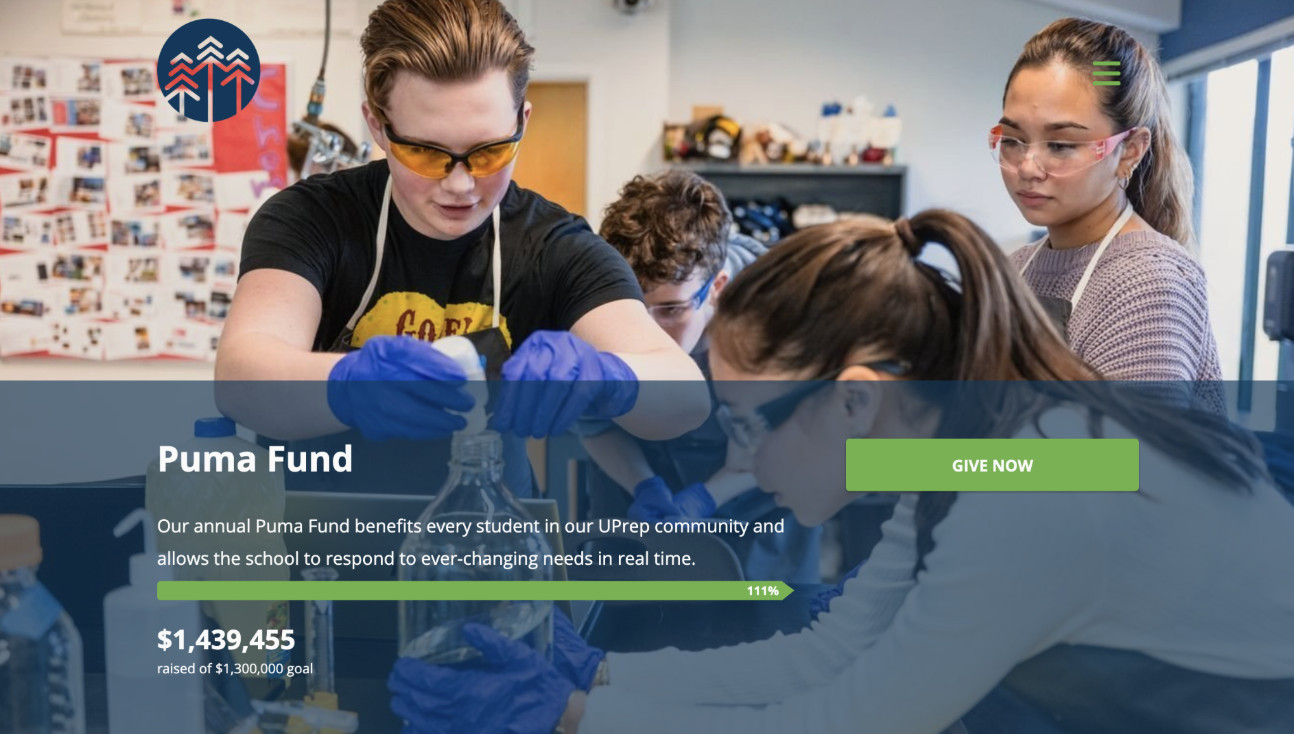
See what your own annual fund page could look like, with leaderboards, giving buckets, and a live progress bar. → Try Boost's Free Annual Giving Page Designer
Starting in July at the top of the new fiscal year, the UPrep development team maps out a full appeal calendar for the Puma Fund. They structure it as a documented timeline that specifies when each constituency hears from the school, and how those touches align with their October push.
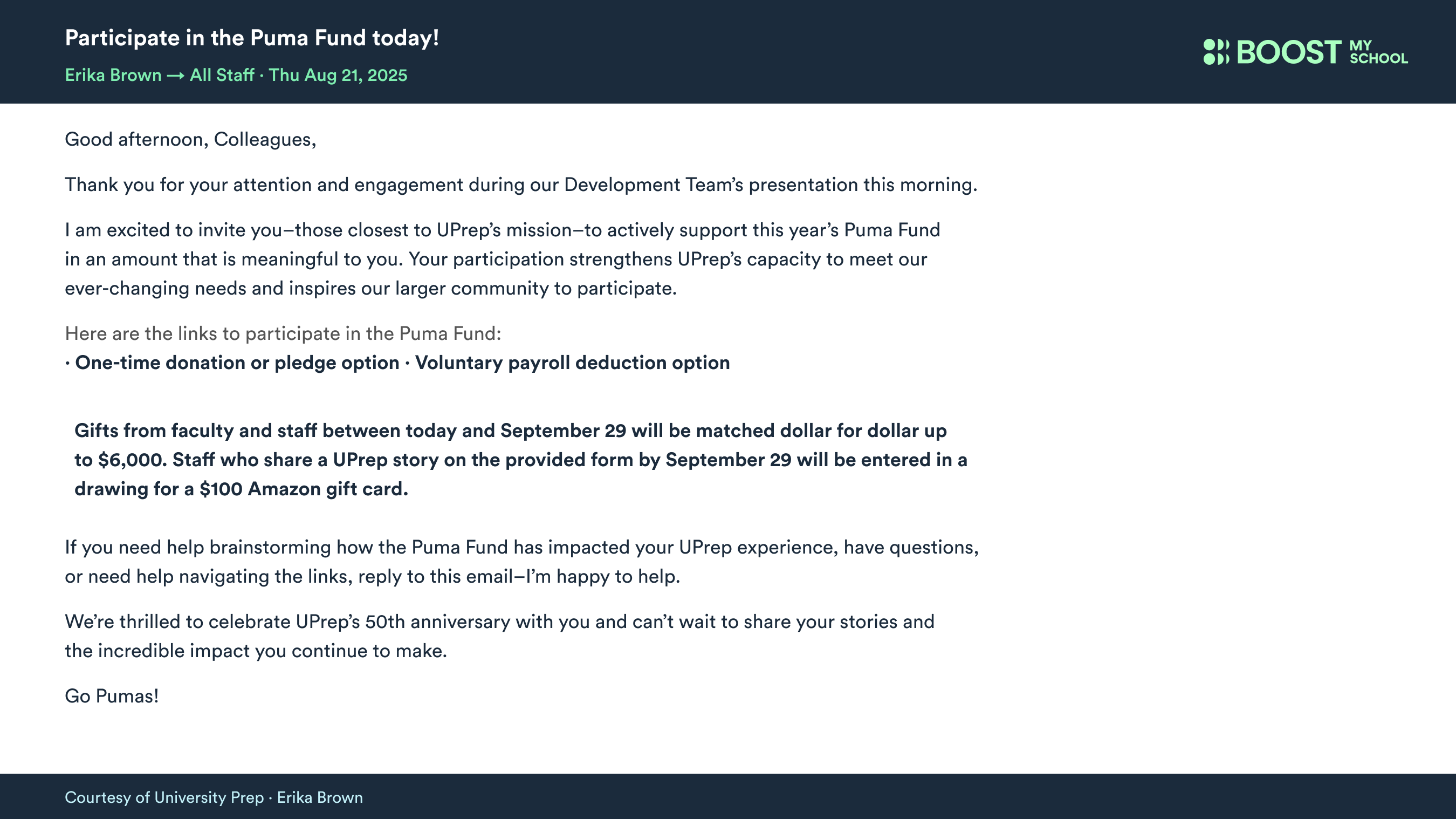
"We intentionally lay out a timeline. We have an appeal calendar for our annual fund—mainly to keep us on track of which segment should go out first, which segment we could wait on."
BEFORE YOUR NEXT APPEAL:
Pull up your current outreach sequence and look at the order. At UPrep, the team sends letters to internal and external constituencies on the same date, but the messaging and volunteer structure behind each group differs.
Every school's logic will be slightly different. The question is whether the order of the production timeline (or appeal calendar) you're using was built around how each group actually relates to your school, or just how you've always sent it.
The last stretch of the Puma Fund is teed up by the development office with class agents leveraging a sense of urgency.
UPrep leverages four to five class agents per grade level, selected through a process that starts in May. Co-chairs serve two-year commitments. New agents are nominated by former agents, by parents who've shown high engagement, and through input from their Parent Guardian Association liaison. The selection criteria center on peer presence in the community, not giving history.
TAKE THIS BACK TO YOUR DESK:
If you don't have a peer outreach program yet, the principle still applies.
Start smaller. Identify one or two parents per grade who are already engaged and willing to send a personal note in the final week. It doesn't need to be formal or structured. One parent texting three families they already know will move more than another email from the development office.
If you have a Parent Guardian Association or equivalent, that's your starting point for finding those people.
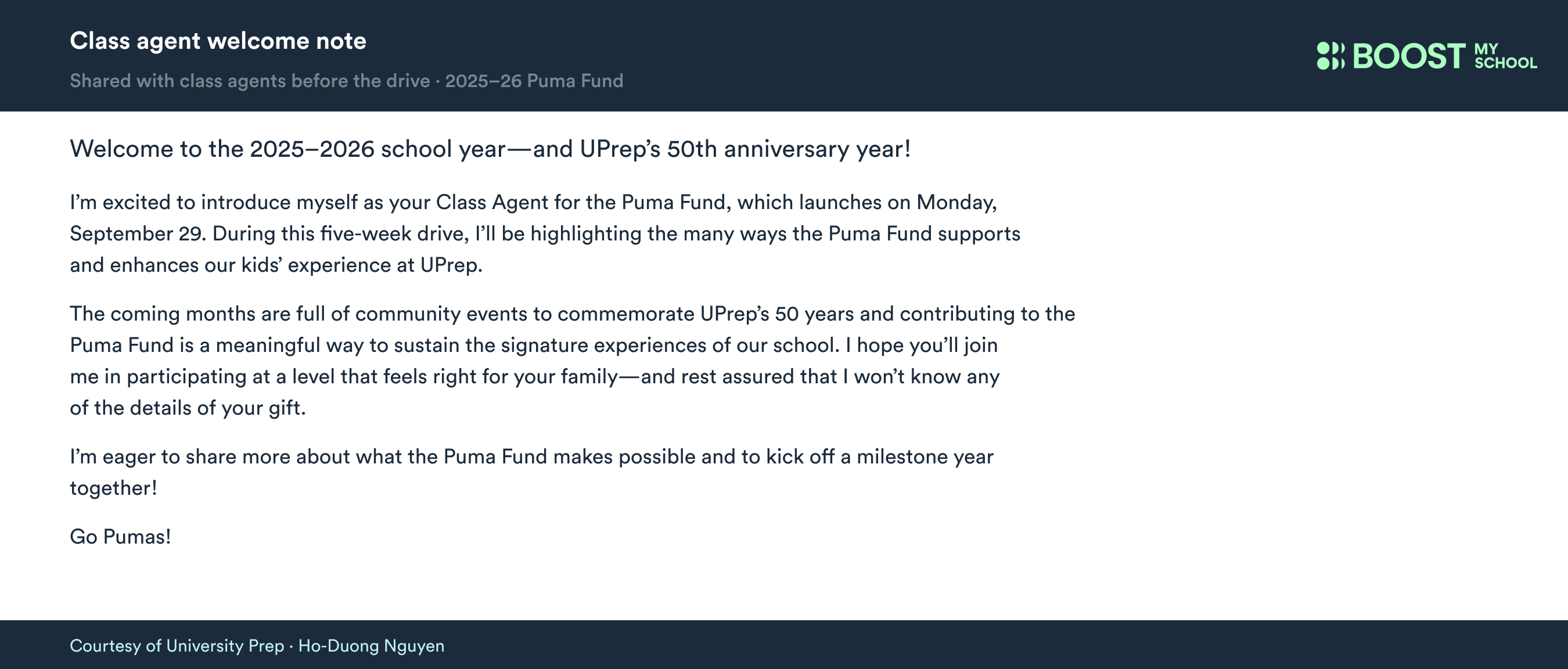
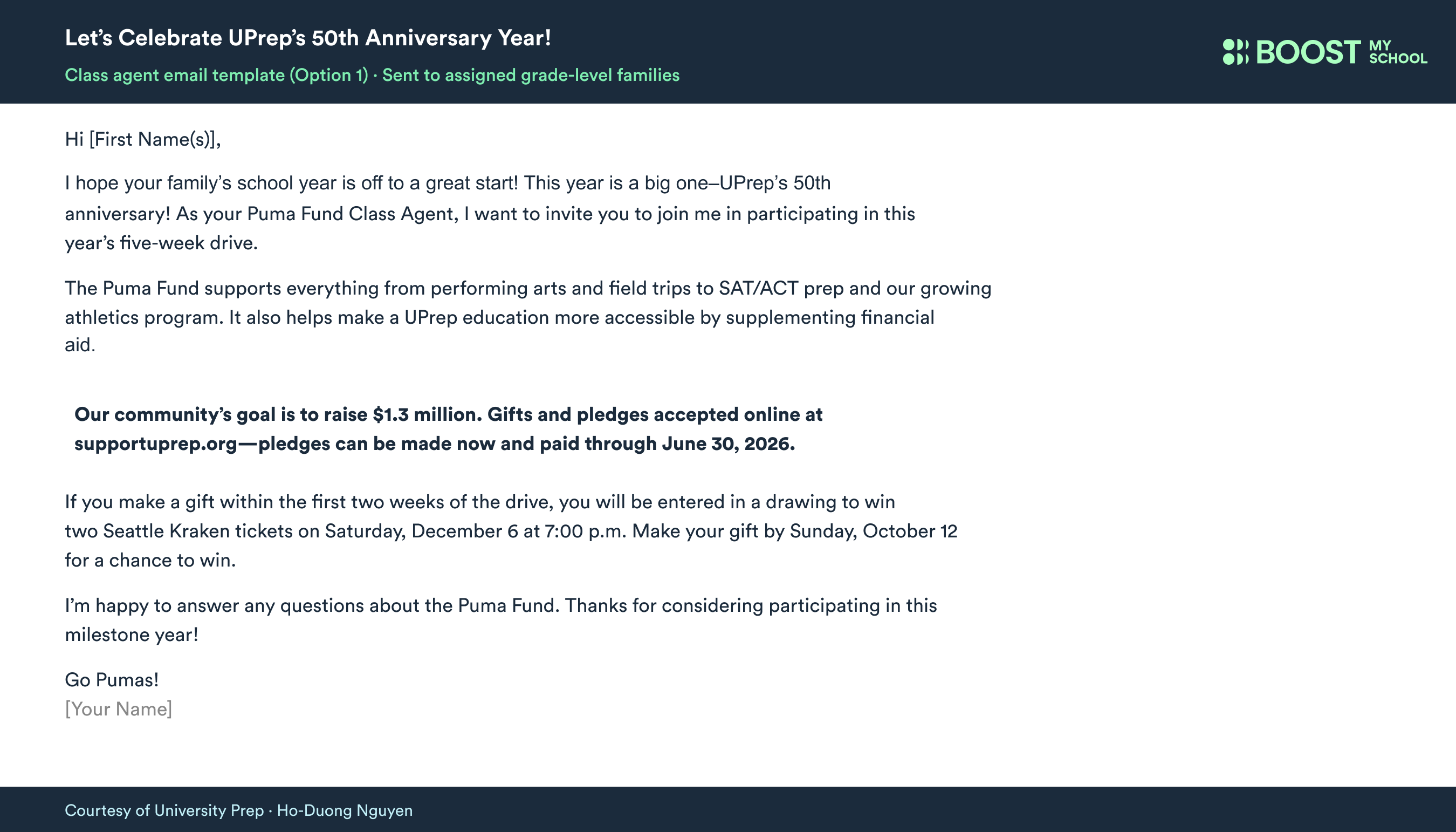
The final outreach runs in waves, with a defined structure for each one.
Mid-drive, if a grade's participation is lagging, the development team reaches out to that grade's agent and asks for a natural follow-up. This can work as a simple peer check-in from someone the family already has a relationship with.
The system of tiered, grade level outreach had been in place for years, and with the added functionality of Boost, UPrep hit their $1.3M goal sooner.
UPrep’s segmented outreach structure meant every constituent group was reached through the channel most likely to get them to act.
Digital wallet access (Venmo, Apple Pay, Google Pay) made it easier than ever to participate. DAF integration allowed major donors to move from the giving page to integrated accounts of their choice (Fidelity, Charles Schwab, and Morgan Stanley) and back to UPrep in a single session. “It’s that easy,” Ho-Duong adds, citing that employer match lookup also ran directly through the giving page. This also lets supporters verify matching eligibility in real time without leaving the site.
"We want it to be less than a minute," Ho-Duong says. "Literally 10 or 15 seconds for them to give."
Current-family participation across giving programs sits at 73%, ten points above the NAIS national average for that metric, alongside a 13% increase in average gift size compared with the years before Boost.
"At the end of the day, success came from a platform that helped us connect the data, the storytelling, and the community more intentionally. It made giving feel more personal and more engaging, and it aligned with who we are as a school."
UPrep's giving focus for the current year is storytelling. The team is working toward giving constituents visual, statistical data that ties their gift to specific student experiences.
On the platform side, leaderboards, additional giving challenges, and in-platform segmented email tools are now part of the program. Boost's built-in email tools mean Ho-Duong can segment and send outreach without exporting to a third-party tool, which cuts a step out of a process that used to require it.
Our constituent records are a mess. How do we start cleaning them?
Start with active constituents, like current families and recent alumni. Remove obvious duplicates, verify email addresses against what you have on file, and reconcile your gift history with what the business office shows. You don't have to clean everything at once. Getting your most active segments clean before the drive gives you the most leverage for that cycle.
How do you reach out to constituents who haven't given in several years?
At first, treat them as a separate segment with a lighter touch. A lapsed constituent who gets the same message as an active annual giver is more likely to feel out of place than motivated. A short, low-pressure note that acknowledges the gap—something closer to "we'd love to welcome you back" than "you haven't given since 2021"—tends to land better. Track responses separately so you can see what's working without it muddying your active-segment data.
How do we run a successful class agent program?
Start with one or two grades where you already have engaged parents and build from there. You don't need full coverage in year one. A class agent in three grades who actually follows through is more valuable than agents in every grade who go quiet mid-drive. Keep the data you give them simple—who has given, who hasn't, nothing more—and set one clear deadline for their outreach window. The less you ask them to figure out on their own, the more likely they are to follow through.