New: Boost's Raiser's Edge NXT Integration now supports Galas, Auctions, and Reunions
Learn More


Three proven systems that help K-12 advancement teams multiply results without adding staff or working longer hours.
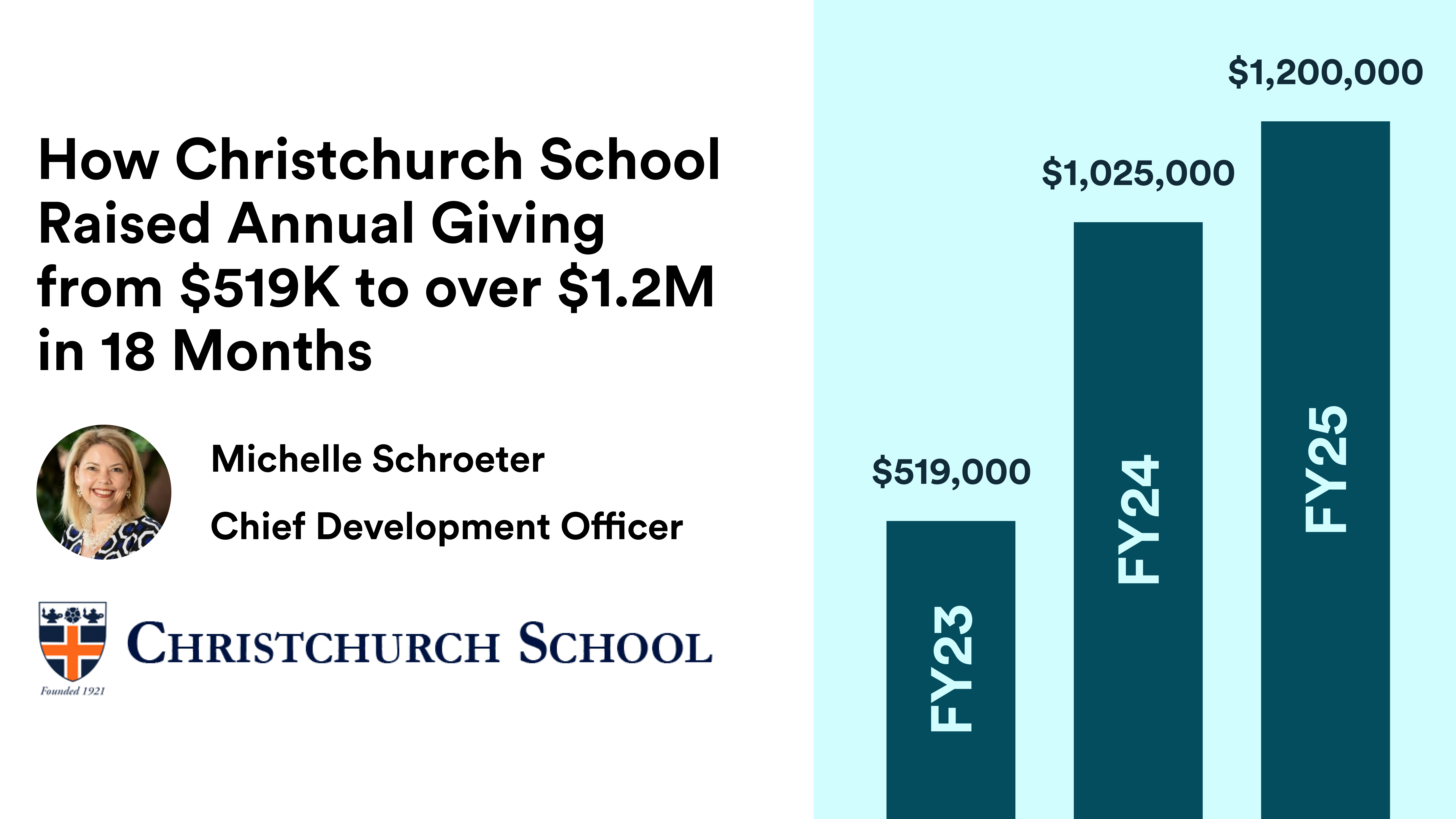
Michelle Schroeter knew her team at Christchurch School faced an ambitious target when she arrived as Chief Development Officer in November 2023. The school had raised just over $519,000 in annual giving the previous year. Christchurch School's Board and Head of School wanted the advancement team to raise $1,025,000 by June 30 (a 97% increase in eight months).
"I took a leap of faith," Michelle says. "I knew we needed a strategy behind that number."
Working harder wasn't an option. Her small team was already managing relationships with hundreds of families across a boarding and day school serving students from 30 countries. Michelle realized working harder or hiring more people wasn’t going to cut it as a solution. So, she built systems that multiply effort instead of piling more work on her small team
By June 30, 2024, Christchurch School raised $1,025,200. The following year, they exceeded $1.2 million.
Three strategic multipliers made this possible: platforms, volunteers, and concentrated events that handle what advancement staff used to manage manually. The system works with any giving platform that tracks donations in real time and displays public leaderboards. It works with class sizes of 15 or 150, and whether your volunteers are seasoned fundraisers or first-time callers. What matters is how you structure the three pieces to multiply each other's effects.
Many advancement teams default to broad email appeals because reaching more people feels like the path to more giving. But Michelle's experience shows this creates a different problem: staff spend increasing time on coordination and follow-up while individual relationships become less personal.
"We want to talk to them about how their gift is impacting the school for today, tomorrow, and the future."
Before implementing their current systems, Michelle's team at a previous school spent hours on manual coordination. "We used to color in the map and put little number tacks on how many people gave from that state," she recalls. Staff members made constant update calls to share campaign progress—work that platforms like Boosts now handle automatically. The results from their Day of Giving validated the need for carefully distributing automation.
You can hire more people or work more hours to compensate, but neither solution scales sustainably. The alternative is building systems where your giving platform handles coordination, your community creates outreach capacity, and concentrated timing generates its own momentum.

Smart advancement teams use technology to automate and empower community inspiration, not just track gifts on the backend. This means choosing tools that generate community activity while reducing the tasks your staff manages manually.
At Christchurch School, Michelle's team used Boost My School’s Giving Platform to handle what previously required constant staff coordination:
Before their Day of Giving, Michelle's advancement team would have spent the entire event refreshing spreadsheets, copying donation amounts into email updates, and manually tracking which class was leading.
Instead, the Boost's leaderboard tool shows current totals by class, by donor segment, by challenge status—updating automatically as gifts arrive. A class agent can text a screenshot to classmates showing their class trailing another by $2,000. Parents can refresh the page and see their grade just took the lead. Every donor could see exactly where their class stands the moment their gift processes.
This freed Michelle and her team to focus entirely on relationship building. During their 24-hour giving window, they made personal calls to prospects, responded to donor questions, and coordinated with volunteer ambassadors. "Real-time giving tracking [in Boost] frees up time for donor calls and other person-to-person interactions," Michelle explains. With this freed up time, she and her team were able to call 100 people personally—impossible if they'd been managing manual gift tracking.

During Christchurch School's Day of Giving, about half of the 378 donors posted messages sharing memories or encouraging classmates. These comments appear instantly on the public giving page for anyone to see.
Here's how this creates momentum without staff work: A class agent who's about to text 15 classmates can pull up the comment wall first. They see that three people from their graduating class already gave and posted heartfelt messages about faculty members or their sailing program.
Now that volunteer isn't cold-asking. They're saying "Hey, did you see what Sarah posted? A bunch of us are giving this year, here's the link." The platform just handed that volunteer social proof and emotional touchpoints without anyone on staff having to create it, package it, or send it over.
Michelle's team doesn't have to moderate, copy-paste testimonias from emails, or even manage the conversations, because community members can see progress instantly on the platform and share that excitement with their networks.

The most effective advancement programs train community members to facilitate authentic peer connections rather than asking volunteers to make asks they're uncomfortable with.
Michelle's team provides volunteers with specific tools and systematic support:
Michelle's class agent system creates a structure where alumni do the actual relationship-building, using tools that make outreach feel natural rather than awkward. This works even if your volunteers have never made fundraising calls before.
Michelle and her team hosted class agent Zooms where they heard the Day of Giving structure explained simply: the overall goal, how class challenges work, what matches are active. They're given a straightforward script that takes the pressure off.
Her team also supplied class agents with their class roster and contact information so they could more easily make connections and build momentum.
Christchurch School organized three student calling sessions during their Day of Giving. "I had the students just ask for a gift,” she explains, “but people on my team and our development committee members actually were asking for a specific amount." Students reached out to the school’s entire network—thousands of alumni—in a single day. A task that would have taken Michelle's team weeks."70% of the gifts, the dollars that we raised that day, were from alumni," Michelle notes. "And we have people who gave that day who had never given. Alumni just love hearing from students about their experiences.”
Create a two-page toolkit for your volunteer ambassadors.
Then schedule two Zooms before your next outreach window, and walk through the toolkit together. Let volunteers practice the talking points with each other so they feel confident before making actual calls.
The 24-hour Day of Giving window compounds all the technology and volunteer efforts. When giving happens over weeks or months, class competition fizzles. Platform updates lose urgency. Volunteer calls feel like just another ask in a long season of asks.
Compress that activity into 24 hours and everything changes: "We set a goal of $100,000, and we ended up raising over $208,000 from 378 donors," Michelle says. "With class agents eagerly reaching out, our students making calls, and class agents helping to bring their classmates along."
The platform's real-time leaderboard becomes genuinely thrilling when rankings shift every 20 minutes. A class that's trailing at lunch sees they could take the lead with just three more gifts. Agents text their classmates immediately. Those classmates give within an hour and watch their class jump from sixth to third place.
Michelle's team monitored which hours saw the highest platform activity and concentrated more volunteer outreach during those windows. "We also watched activity on the platform and shifted more outreach into the times when donors were most active to keep the momentum steady," she explains.
The breakthrough came at 8 PM when they'd reached $160,000—well past their original $100,000 goal. "A supporter reached out about a new giving match," Michelle recalls. "And at that moment, we were at $160,000. And their offer helped push us to get over $200,000."
The team immediately announced the new match opportunity. Class agents who'd finished their calls two hours earlier jumped back on the phone. The final four hours produced $48,000 in additional gifts.
"I’ve never seen this team so energized after a Day of Giving," Michelle says.
Michelle's team uses Boost My School's text marketing tool for time-sensitive updates. 'I feel like people treat their phones like an extension of their body—you're not checking your emails as much,' Michelle explains.
After the campaign, she continues building connections:
'I will personally text them and just let them know that we got to the goal, and this is what your dollars helped us to provide for that year, and thank you for your support.'"
These campaign updates are also included in the school's impact report, which features Day of Giving results alongside donor stories.
Michelle's system produces results that feel impossible for an advancement team: $519,000 to $1.2M+ in 18 months. A single Day of Giving that generated $208,000 in 24 hours. 378 donors participating, many giving for the first time.
The system works because each multiplier compounds the others. Technology creates real-time competition that motivates volunteers. Volunteers generate the stories and social proof that appear on the platform. Concentrated timing makes both effects dramatically more powerful.
"I don't feel like every time you call, you should be asking for money," Michelle says. "Because if you do, it's very transactional. I really feel the relationships with people are so important that it shouldn't always be about money."
That philosophy drives everything about how Christchurch School built their Day of Giving, and it’s something that any small advancement team can achieve with the same kind of results. You just need systems where technology, people, and momentum each multiply what the others make possible.
How do small teams find time for all this relationship building?
Community-centered strategies actually save time long-term by creating supporters who participate proactively rather than requiring constant cultivation. The upfront investment in systematic relationship building pays off through higher participation rates, more consistent giving, and community members who actively promote school initiatives without ongoing staff management.
What if leadership expects immediate results from advancement initiatives?
Present relationship-building strategies alongside short-term tactical execution rather than as alternatives. Christchurch School's Day of Giving delivered immediate results ($208,518 in 24 hours) while building sustainable long-term support. Schools that implement both simultaneously demonstrate ongoing progress while investing in future success.
How do you measure success of community-building compared to traditional metrics?
Track engagement indicators alongside financial metrics: volunteer participation rates, event attendance, and multi-year giving retention. Christchurch School saw 70% of Day of Giving dollars come from alumni, with nearly half of donors posting comments and sharing memories. These engagement measures demonstrate program effectiveness to stakeholders while building the foundation for future giving growth.